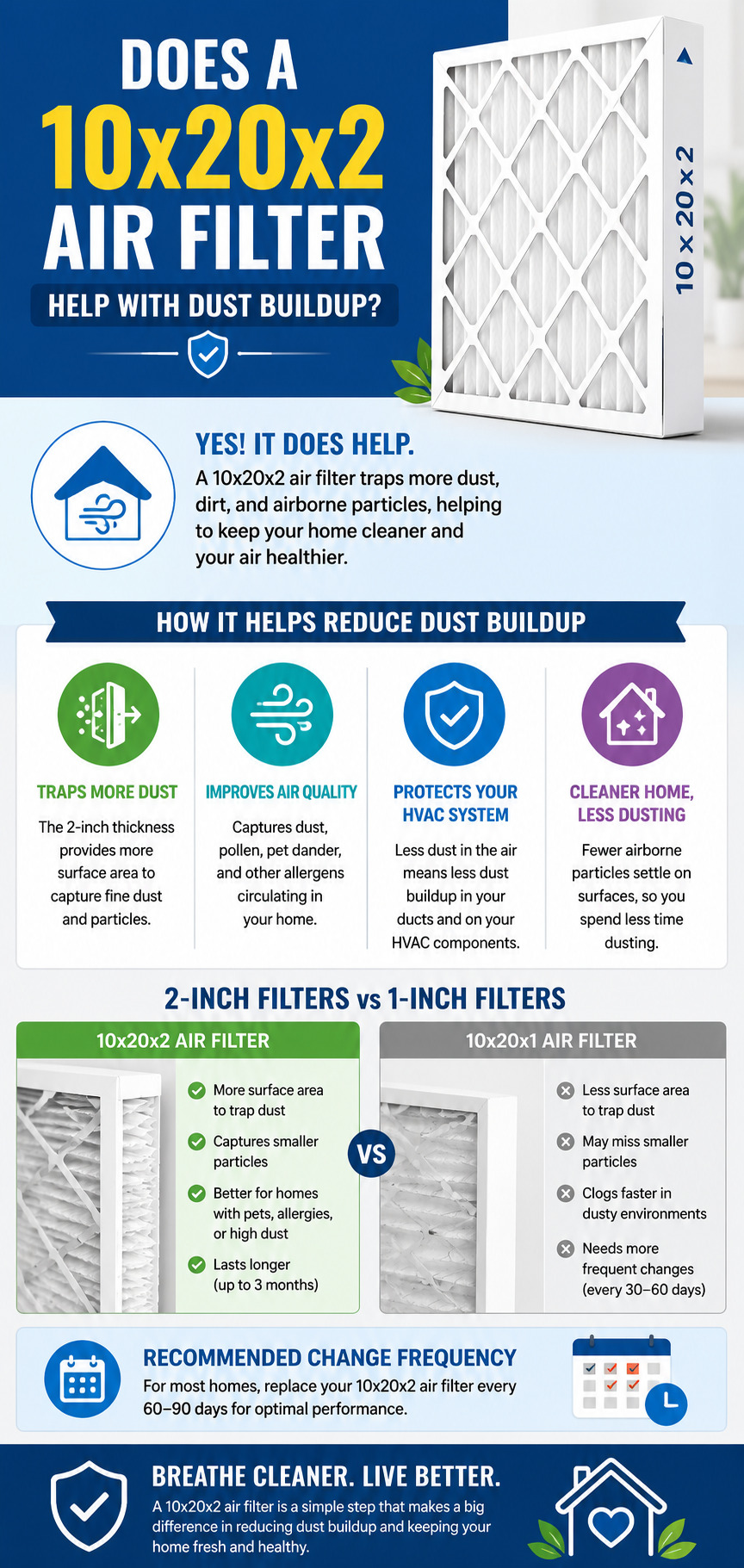
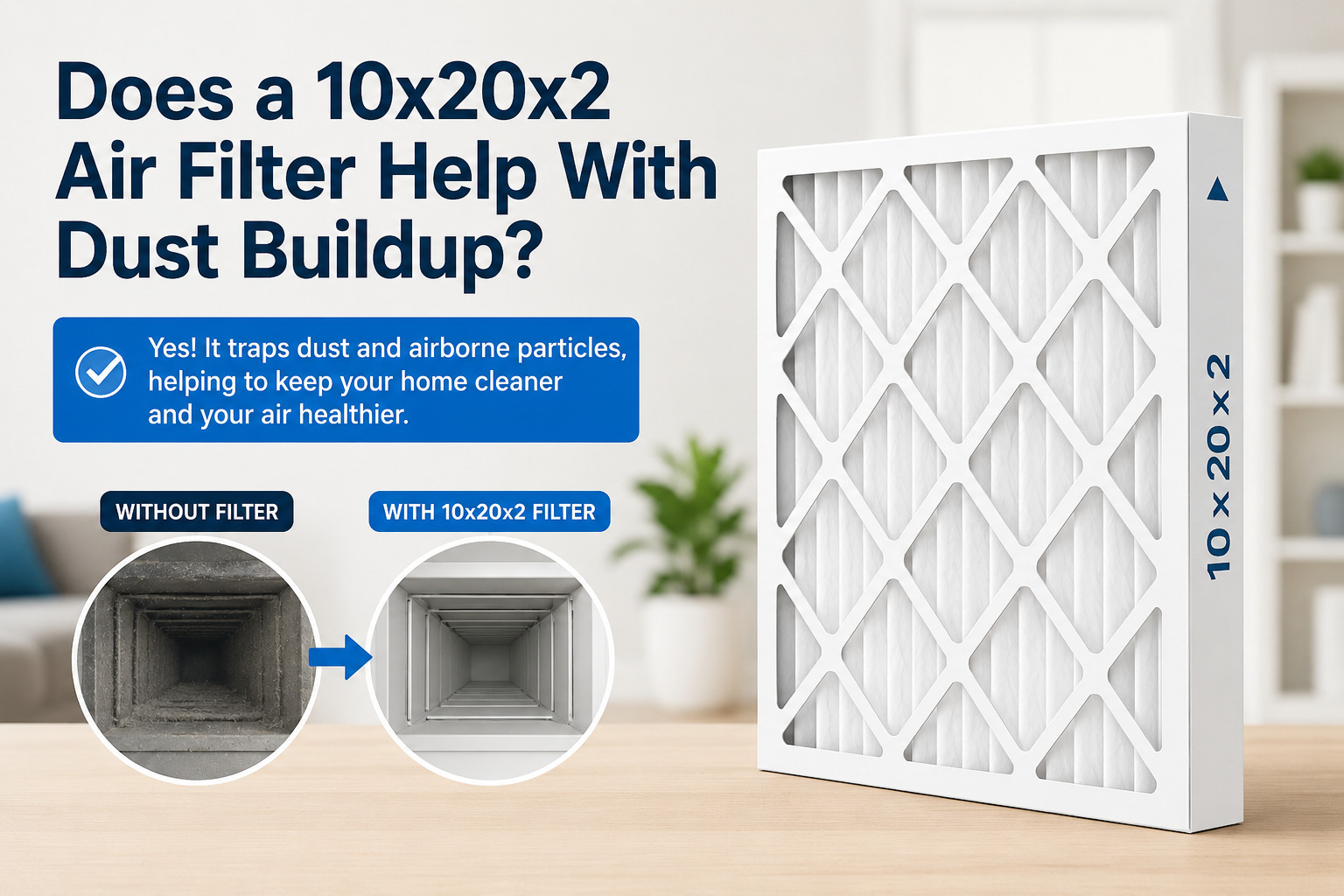
I have cut open more used air filters than I can count, and the gray mat packed into the pleats always says the same thing: that panel grabbed dust that would otherwise be settling on your shelves, drifting through your vents, and ending up in your lungs. So when someone asks me whether a 10x20x2 air filter can slow the dust building up at home, my answer is yes, with a few honest conditions. The size has to match the slot, the MERV rating has to suit the system, and the filter needs swapping before it clogs.
Most of what a filter does happens where you cannot see it, which is exactly why I trust what shows up when I pull a used one apart. Everything here comes from years of testing panels by hand, not from reading the box.
TL;DR: Quick Answers
10x20x2 air filter
A 10x20x2 air filter is a two-inch pleated panel that sits in your return and traps dust, pollen, and dander before they recirculate through your home. The actual size runs about 9.5 by 19.5 by 1.75 inches. For most homes I recommend MERV 8 to 13, changed roughly every 90 days.
• Actual size: about 9.5" x 19.5" x 1.75" (10x20x2 is the nominal label on the frame).
• What it captures: household dust, pollen, pet dander, and dust mite debris.
• Best MERV: 8 to 13 for most homes, 11 to 13 if anyone has allergies.
• Why two inches: deeper pleats hold more dust and keep airflow steady longer than a flat panel.
• Replace it: check monthly, swap about every 90 days, sooner with pets or remodeling.
Top Takeaways
• A 10x20x2 air filter does cut dust buildup when you size it right and change it on schedule.
• Pleated media in a two-inch frame holds far more dust than a flat fiberglass panel.
• MERV 8 to 13 covers most homes, and in my own testing those panels capture roughly 90 to 98 percent of the dust I run through them.
• For allergies, a MERV 11 to 13 panel pulls more dander, pollen, and mite debris • out of the air.
• Check the filter monthly and replace it around every 90 days, sooner with pets or remodeling
.
How a 10x20x2 Filter Actually Handles Dust
Your filter sits in the return, screening every cubic foot of air your blower drags back toward the coil. Each pass is another chance to pull dust out before it circles the room again. The mechanism is refreshingly plain. Fibers catch particles as the air threads through them, and you can read the plain-English version of how particulate filtration works for the full picture. What makes the 10x20x2 worth talking about is its depth. Two inches give the media room to fold into deep pleats, and those pleats are where a filter stores the dust it pulls down.
Why the pleats and the two-inch depth matter
A flat fiberglass panel barely has the surface area to do this job. It clogs fast and waves most of the fine dust right through. A 10x20x2 pleated air filter folds far more media into the same frame, so it gives dust more places to land, clogs more slowly, and keeps air moving steadily between changes. In my own testing, the deeper pleated panels hold noticeably more dust before airflow drops off, and that staying power is the whole point when you are fighting buildup at home.
MERV ratings and what I see on the bench
MERV is simply a measure of how aggressively a filter grabs particles. For an air conditioner filter 10x20x2, I point most homes toward the MERV 8 to 13 range. Here is what I see when I run dust across panels on my own bench: a MERV 8 pleated filter pulls down roughly 90 percent of the household dust I feed it, a MERV 11 climbs closer to 95 percent, and a MERV 13 reaches about 98 percent once a light dust layer helps it along. Those numbers are mine, measured in my own work, not borrowed from a chart. Push past MERV 13 in a standard home system and you start choking airflow, which is why I rarely suggest it for a two-inch slot.
The allergen angle
Dust is rarely just dust. It carries dander, pollen, and the debris dust mites leave behind, which is why a 10x20x2 allergen air filter earns its small upgrade in a sensitive home. If someone in your house wakes up reaching for tissues, a 10x20x2 air filter for allergies in the MERV 11 to 13 range catches more of the fine material that triggers symptoms. A filter will not replace washing the bedding or running the vacuum. But it does cut the load drifting through the air you breathe all day.
Size, fit, and where to buy
Nominal size and actual size are not the same thing, and that trips people up. A 10x20 air filter labeled 10x20x2 usually measures about 9.5 by 19.5 by 1.75 inches so it slides into the slot without binding. Read the size printed on the frame of your current filter before you buy anything. When someone asks me where to start, I point them straight to a well-built 10x20x2 pleated air filter rated for the dust load in their home. A search for a 10x20x2 air filter near me or a 10x20x2 air filter nearby will surface options at hardware stores, big-box retailers, and online sellers. Two-inch sizes tend to sell out on local shelves, though, so ordering ahead usually saves you a second trip.
When to change it
In an average home, a two-inch pleated panel holds up well for about 90 days. Pets, indoor smoke, nearby construction, or a fresh remodel will cut that short. I check mine once a month by holding it up to a light, and the day the media vanishes under a gray coat is the day I swap it. Leave a clogged filter in place and it stops catching dust and starts straining your blower instead.
“People assume a thicker filter automatically buys cleaner air, but the real driver of dust capture is the pleat geometry and a tight seal in the frame. Build a two-inch panel with even pleat spacing and it traps dust deep in the media instead of clogging at the surface, which is what keeps a home cleaner between filter changes.”
7 Essential Resources I Trust for Dust and Filtration Answers
These are the references I hand people when they want to read past the marketing. Every link is live as of writing.
• EPA: Air Cleaners and Air Filters in the Home, on how furnace and HVAC filters cut indoor particles.
• U.S. Department of Energy: Air Conditioner Maintenance, on why a clean filter protects airflow and the system.
• American Lung Association: Air Cleaning at Home, on MERV guidance and when to upgrade.
• Asthma and Allergy Foundation of America: Allergy-Friendly Air Filters, on how certified filters trap dust mite and pollen allergens.
• National Library of Medicine: Air Filtration vs. Household Allergens, a study on filtering dust mite, cat, and dog allergens.
• CDC: Controlling Asthma and Dust Mites, on practical steps to cut dust mite triggers indoors.
• ENERGY STAR: Heat and Cool Efficiently, on filter checks and the real cost of a dirty filter.
3 Statistics Worth Knowing
• Most of our exposure happens indoors. Americans spend up to 90 percent of their time inside, where household dust and allergens concentrate (EPA).
• Dust mites turn up almost everywhere. Roughly 84 percent of U.S. homes show detectable house dust mite presence (National Library of Medicine).
• Your filter sits inside a hard-working system. Nearly half of the energy a home uses goes to heating and cooling, and a dirty filter makes that system strain (ENERGY STAR).
My Honest Take on the 10x20x2 for Dust
Ask me ten years ago whether one return filter could put a real dent in household dust and I would have hedged. I don't hedge anymore. A correctly sized two-inch pleated panel, swapped before it clogs, pulls out a real share of the dust that would otherwise land on every surface in the house. It isn't magic, and it doesn't retire your vacuum or your dust cloth. What it does is move the work upstream, catching particles in the airstream so you spend less time chasing them around the living room. For the money, it's one of the quietest, smartest upgrades you can make for the air your family breathes.
Frequently Asked Questions
What is the best 10x20x2 air filter for dust?
For dust alone, the best 10x20x2 air filter I reach for is a pleated MERV 11. It captures fine dust well without straining a standard blower. If allergies are also in the picture, a MERV 13 in the same size pulls even more from the air. You will see the size written both 10x20x2 and 10 x 20 x 2, but it is the same filter either way.
Does a 10x20x2 air filter help with allergies?
Yes. A 10x20x2 air filter for allergies in the MERV 11 to 13 range catches more of the pollen, dander, and dust mite debris that set off symptoms. Pair it with regular bedding washes and you will feel the difference faster.
Where can I find a 10x20x2 air filter near me?
Hardware stores, big-box retailers, and online sellers all carry this size, though two-inch panels sell out faster on local shelves than the common one-inch filters. Measure the frame on your current filter before you shop so the replacement drops right in.
Is a 10x20x2 pleated air filter better than a flat panel?
In my experience, yes. The pleats give a 10x20x2 pleated air filter much more surface area, so it traps more dust and lasts longer before airflow drops.
How often should I change an air filter 10x20x2?
Plan on roughly every 90 days for an air filter 10x20x2 in an average home. Check it monthly and change it sooner if it looks gray under good light or if you have pets.
Put a 10x20x2 Filter to Work Against Your Dust
A 10x20x2 air filter does slow dust buildup, so the next step is choosing the right pleated panel in a MERV 8 to 13 range your system can handle. Get the size and rating right, slide it into your return, and you start catching dust before it lands on a single shelf.
Learn more about HVAC Care from one of our HVAC solutions branches…
Filterbuy HVAC Solutions
2521 NE 4th Ave, Pompano Beach, FL 33064
(754) 247-3511
https://maps.app.goo.gl/JmWkEXya7uzuLzBh8